Comparing note apps often starts with features: backlinks, databases, canvases, AI, or transcription. A better starting point is simpler: what shape does your information have when it arrives, and how will you look for it later?
A research conclusion that needs careful editing, a photo of a whiteboard, and an expense that must appear in a monthly total are all notes. They should not be forced into the same container.
Three structures for three kinds of work
| Structure | Best for | Main advantage | Common cost |
|---|---|---|---|
| Conversational | Small observations, photos, voice, files, and ideas that grow over time | Fast input with a natural timeline | Poor fit for elaborate layouts and field-based reporting |
| Document | Essays, proposals, research notes, and durable explanations | Coherent structure for reading and collaboration | Titles and sections add friction during quick capture |
| Database | Clients, project states, media logs, expenses, and other repeated records | Consistent fields, filters, and calculations | Templates can interrupt ideas that do not fit the schema yet |
None is inherently more advanced. The useful question is whether the container matches the material.
Look at the input first
If you usually sit down knowing that you need to write a particular piece, a document is a natural choice. Its title and sections are not overhead; they are part of the thinking process.
If information appears while walking, reading, or moving between meetings, it may be one sentence, one image, or a short recording. It is often too early to justify a new document. A conversational notebook lets you save one message now and continue the same topic later.
If each item has stable attributes from the beginning—amount, date, owner, status—a database prevents repeated cleanup and makes the collection measurable.
Then look at retrieval
Different tools support different kinds of memory:
- If you remember a title and its place in a hierarchy, documents work well.
- If you remember a topic, a phrase, or roughly when something happened, Threads and full-text search are a better fit.
- If you need “open items from this month above $500,” you need database filters rather than prose search.
Consider a product discussion. A whiteboard photo, a short interpretation, and a post-meeting voice memo belong together while the idea is forming. Once the conclusion stabilizes, it can become a proposal. If the resulting actions need owners and due dates, those belong in a task or database system.
Do not make one tool carry every job
A durable workflow often looks like this:
- Capture raw material through a low-friction entry point.
- Keep related observations near the same topic.
- Turn the material into a document when someone needs to read it as a whole.
- Convert it into structured data when you need filtering, reporting, or automation.
This is not an argument for constantly moving notes. Many captures only need to remain searchable. Add structure when it creates a specific benefit, not because every fragment must become a permanent document.
Where OrbNote fits—and where it does not
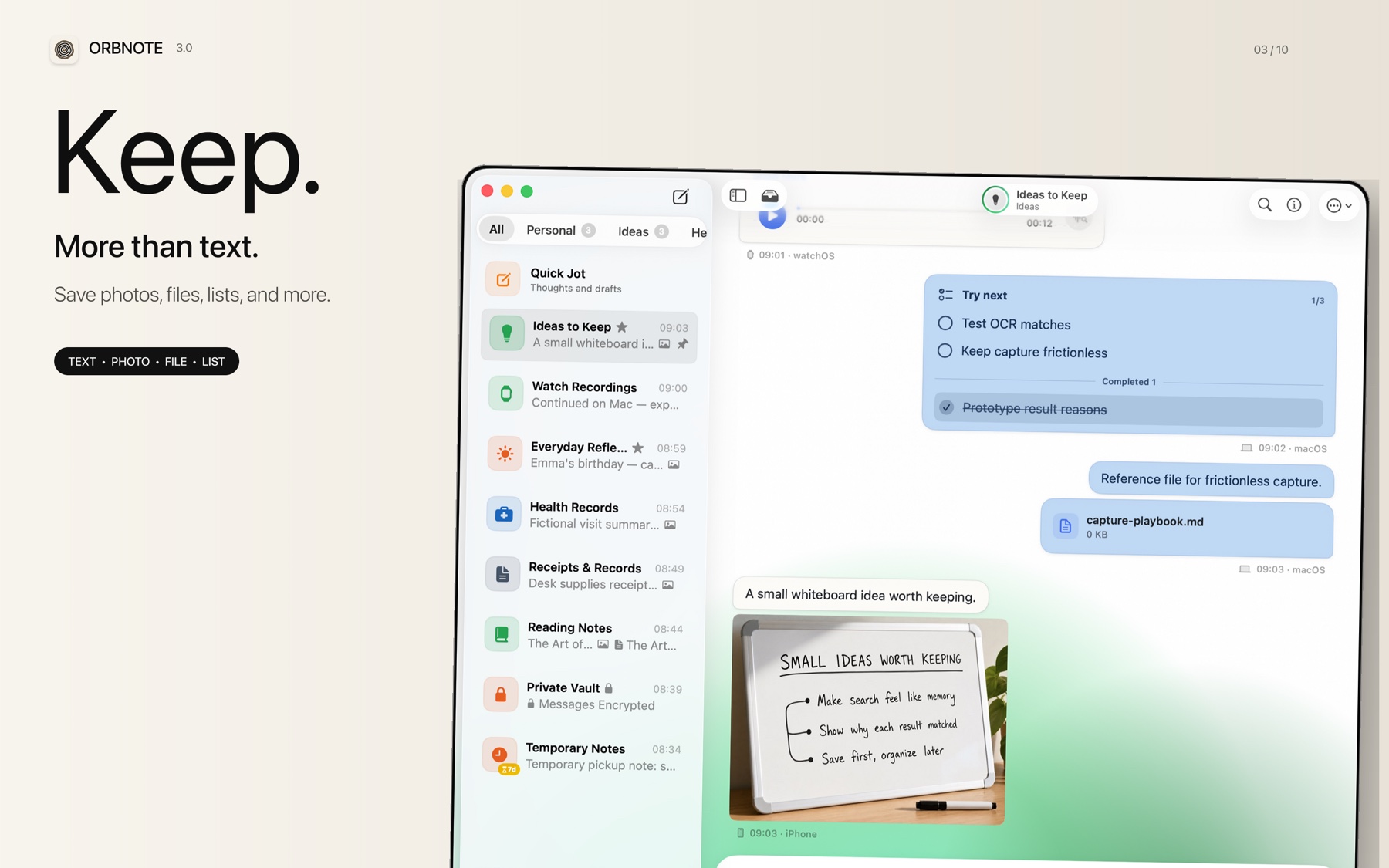
OrbNote is organized around messages and Threads. A message can contain text, photos, audio, files, or a checklist, which makes it suitable for frequent capture and topics that develop over time. Quick Jot accepts material without a final destination; later, you can move or merge messages.
It is not intended to replace every specialist tool:
- A dedicated document editor is usually better for long-form layout and live collaboration.
- A spreadsheet or database is better for formulas, relational fields, and dashboards.
- A project manager is better for dependencies, resourcing, and formal schedules.
Conversational notes are a strong fit when your recurring problems are “I could not capture it in time” and “I no longer remember where I put it.” They are not the answer to every reporting or collaboration problem.
A three-question test
When comparing note-taking systems, ask:
- How many decisions must I make to save a real piece of information?
- What clue will I use to retrieve it three months from now?
- Does the value of this structure exceed the cost of maintaining it?
Those answers reveal more than a feature checklist ever will.